The Chain
Before the Pack, there was only the Chain: a frozen world strung together by relays, masts, data towers and nodes. Signal is what keeps anyone alive there. It runs the power in your block, the door that knows your face, and the keys to everything you own. Whoever owns the backbone relays, and writes the contracts that run the districts, owns everyone who depends on them.
So the owners launched promises. A new district, a season of shelter, a share of something better. People locked their keys into the vaults to join. Then, when it suited the people who wrote the terms, the floor was pulled out from under them, quietly and legally, and they called it maintenance. Out on the Chain they call that a rug. After enough of them, broken contracts spilled bad logic across the map, districts stood half-empty, and most people stopped believing anything at all. That suited the owners. People who believe nothing never organise.
The rigger who read the terms
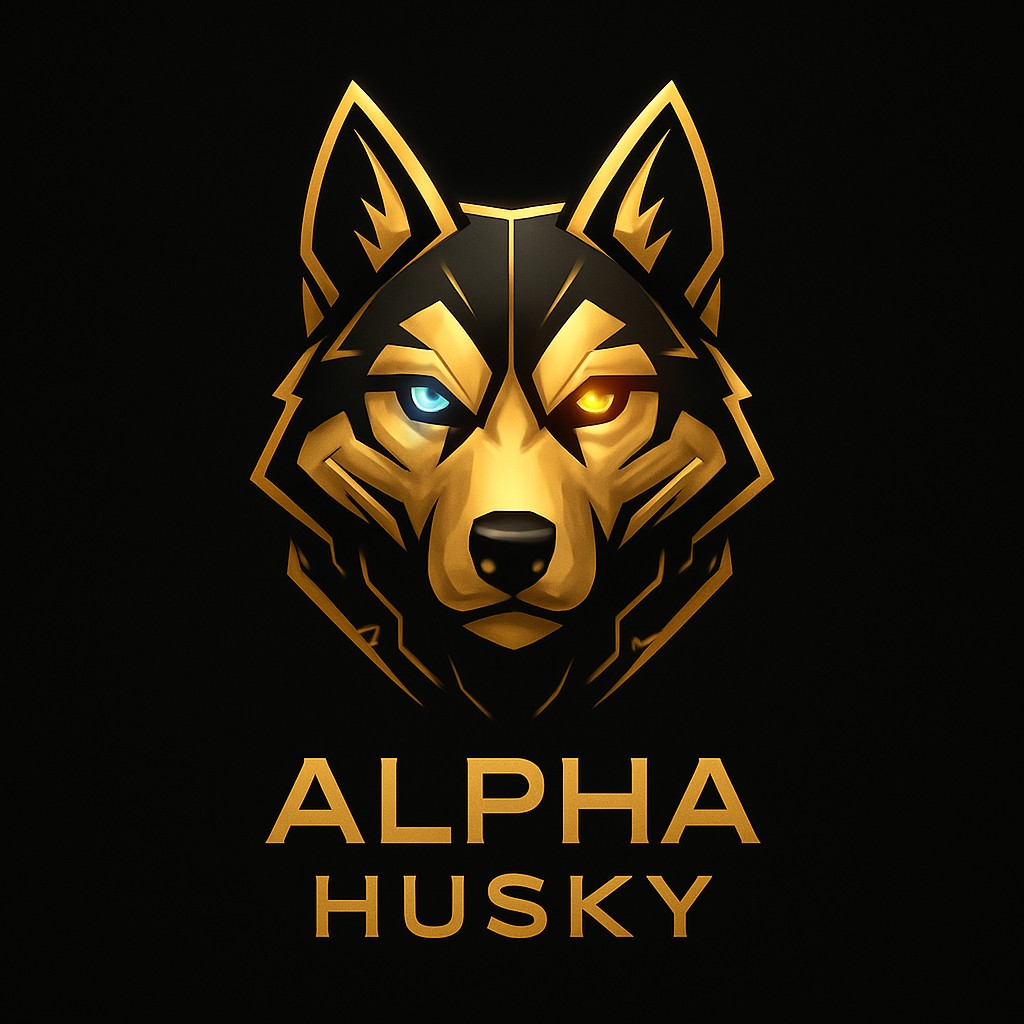
Alpha was a cyber-husky who climbed for a living. He raised and patched the relay towers of the Relay Fringe, salvaged hardware in the Testnet Wastes, and went up first and came down last, which is how the other riggers came to call him Alpha. It started as a complaint, and he wore it as a compliment, mostly to annoy them. He was fast, mouthy and impossible to keep employed by anyone who wanted obedience. He howled the towers' notes back at them, badly. One eye was ice-blue and the other amber, and both were usually looking at something he wasn't supposed to touch.
What changed him wasn't a vision. It was a maintenance job. On a district he had wired himself, with a friend's keys inside the vault, he found the trap written plainly into the public terms and built into his own relays. Nobody had lied. He had been used to build a perfectly legal floor that was scheduled to drop.
He could have warned only his friend. Instead he put the hidden schedule on every public screen in the district and signed it with his own name. The residents got their keys out in time. The district went dark, his credential was revoked, every tower hatch on the Fringe closed to him, and the people he had saved were not all grateful. It was the first time anyone had seen him prove something and take nothing for it.
The Protocol and the Moon Lab
Without a credential, nothing on the network would open for him, so he went where nobody owned anything: the Testnet Wastes. There, cold and half-starved and too stubborn to leave a strange signal alone, he found a hidden protocol, buried and forgotten in a dead relay older than anything he had ever climbed. Who wrote it, and why it was buried, nobody knows.
The Protocol did one thing the Chain had never allowed. It kept a record that anyone could read and no one could secretly rewrite, showing exactly who had signed each entry. It could not tell you whether a promise was true. It could only prove that it had been made, by whom, and that it had not been changed since. For the first time, people could check a promise before standing on it.
That was dangerous, and Alpha, delighted with himself, told the whole Fringe where to find it. The owners of the backbone traced it, cut the relay, and took him to the Moon Lab: a gleaming research citadel that promised to improve the Chain and was, underneath, a prison disguised as innovation. They wanted his Protocol on a leash. They tried to rewrite him, to collar the code and to collar him with it.
He mapped every vent, every node, every variable, and talked to everyone the Lab had broken: burned-out riggers, engineers who had refused one last order, people taken for their keys. When the night came that the Lab's attention drifted, he could have slipped out alone. He opened the cells instead. Part of the Lab came down behind them, and not everyone made it out. Alpha did not pretend that was anyone's fault but his own.
The Pack
The survivors owed him nothing, and they did not agree on much. Some wanted revenge. Some wanted to vanish. What held them together was not Alpha's voice but what they saw him do: put his own mistake on a record that could never be erased, then keep a promise to people who had every reason to doubt him, in a way they could check with their own eyes.
Out of that came one plain rule, the Rug-Never oath: never pull the floor from under someone who stands on your word, and prove it before you ask to be believed. On the Protocol, Alpha coded a signal that the registered systems ignored and only the unregistered seemed to hear. Outcasts, collarless riggers and emptied districts began to answer, one kept promise at a time. That was the Alpha Network. That was the Pack. Anyone could leave, and that was why staying meant something.
Hunters, fear and the Meme War
A Network that makes promises checkable is bad for anyone who profits from broken ones. A hidden directive went out: eliminate the anomaly. Moon Hunters swept through the Phantom nodes, and the Pack scattered across hidden routes, splitting its knowledge so it would never again live in one place.
When the hunters could not break the Pack, its enemies tried to break belief instead. They flooded the relays with fear, saying the Network was a trap and Alpha a raider. The Pack answered with proof, and with jokes that had teeth. In that war a stranger appeared on top of a shattered data tower, the Blood-Moon's Whisper, with one red eye and no known origin, and his signal led the Forgotten Ones in: survivors burned by earlier cycles, cynical and ragged, who joined only after checking for themselves. For a moment it worked.
The Fracture
Then something older than the Chain stirred. At its Edge, Alpha found a doorway that was not coded and not mapped, and a voice there, the Oracle of Rugs, warned that the Chain could not be flipped; it had to be rewritten. What exactly Alpha found at the Edge, he never fully shared. And the Pack began to argue about the Rewrite: whether to hold what they had, or to change the Chain itself.
Then trust broke again, and this time it fractured within the Pack. A route the Network had verified as safe was not. The record was genuine and the route was false, and convoys and vaults paid for it. This was the Betrayal Hash. In the chaos that followed, whole wallet districts emptied, leaving ghost towns of lost keys and forgotten treasures. The trace seemed to point inward, but evidence is not a verdict: to this day no one has proven who did it, or even whether the betrayer was one of the Pack. Alpha refused to condemn anyone without proof. Half the Pack called it principle; half called it weakness.
The Network could not survive as one body. It became four war-paths, each still loyal to Alpha's rebellion, differing in how they believe the Rewrite can be survived, and each shaped by what its people had lived through. Inner Howl, who remembered the friends lost in the hunts, holds the line through loyalty, discipline, defence and endurance. Rogue Byte, who knew the enemy's systems from the inside, turns rebellion into sabotage and fast strikes within the system itself. Pack Burners, who had never spent their anger, bring fire, pressure, offence and the revolt of whole communities. Echo Wardens, who had watched the Pack's memory nearly lost, guard knowledge, strategy and the Pack's legacy. Each kept a last command bunker of the old unified rebellion. Where Alpha went after the Fracture, the Pack does not agree. His trail is still out there.
What the Pack Kept
An epilogue to The Chain Remembers
The Damage That Stayed
The Fracture split the Alpha Network. It did not undo the rugs.
Across the Chain, abandoned wallet districts still carry the cost of promises their residents did not write. Keys have been lost. Homes have gone dark. Doors that once opened no longer welcome the people who depended on them. None of that began with the Betrayal Hash. The damage was already there, left by owners who could pull the floor from under a district and call it maintenance.
The Moon Lab stands abandoned, though its floors are still guarded. At the Phantom Node, the Pack holds the line against the Static Maw. Elsewhere, the work is quieter: patching a cable, recovering parts, finding a way to keep a block connected for another night. The Chain is not one endless battlefield. People still have to live in it.
Four Ways, One Rebellion
The Betrayal Hash exposed a truth the Pack could not ignore. The Network had verified a route as safe. Its record was genuine. The route was not. Convoys and vaults paid for that failure, and no one has proved who was responsible.
The Pack could no longer hold together as a single Network. Inner Howl chose to stand firm and endure. Rogue Byte learned to strike at control from inside its own systems. Pack Burners refused to answer oppression with silence. Echo Wardens held on to knowledge and the record of what the Pack had nearly lost.
They still disagree about the Rewrite, and about Alpha's refusal to condemn anyone without proof. Those arguments matter. But the four war-paths are not four enemy armies. Each is still part of a rebellion founded on the same oath: do not pull the floor from beneath people who trust your word.
The Weight of Proof
For most of the Chain, survival is decided by things smaller than battles. A door. A working relay. A route someone says is clear. The name attached to that claim.
The Protocol can preserve a promise and show who made it. It cannot make the promise true. A signed route still needs someone to check it. If it fails, the record matters — but so does what the person responsible does next.
And not every failure is another rug. Steel wears out. Connections break. People get things wrong without plotting against anyone. After so much deliberate harm hidden behind ordinary words like maintenance, knowing the difference is difficult. It is also necessary. A world where nobody can believe anybody cannot rebuild.
Without Alpha in the Room
Alpha is not there to settle the arguments. What became of him after the Fracture remains unknown. His trail is still out there. Some Howlers follow it, but the Pack cannot postpone every choice until the trail leads somewhere.
It began because people saw him admit a mistake and keep a promise they could check for themselves. No speech could have replaced that. No record can replace the work now.
Sometimes that work means checking a route before anyone travels it. Sometimes it means owning a loss instead of hiding it, or repairing something that will never carry your name. None of it restores an entire district overnight. It does, however, give someone a reason to trust again.
The Fracture left the Pack divided. It did not release the Pack from its oath.
What the Pack kept was a promise it still has to prove.
The signal you heard
That is the world you enter. The Network is damaged but alive. Four factions hold their own fronts. The Moon Lab stands abandoned, its floors still guarded. At the Phantom Node the Pack holds the line against the Static Maw. The Edge still frays into static, and the old questions are still open.
You are not Alpha. You are a Howler: one member of the Pack, with your own name, your own gear and your own war-path to choose. When a faint trace reaches you over Pack radio, and one of two signals keeps answering, it echoes the way the Pack once called the uncollared. Who sent it, and why it found you, is yours to discover. Follow it. Find what Alpha left behind. Then decide what you'll build on it, and whether you'll keep your word when it counts.